Astérix in Lusitania
Presentation
Writer: Fabcaro Drawings by: Didier Conrad |
Publisher: Les Éditions Albert René Publication date: 23rd October 2025 |
Destination Lusitania, by Toutatis!
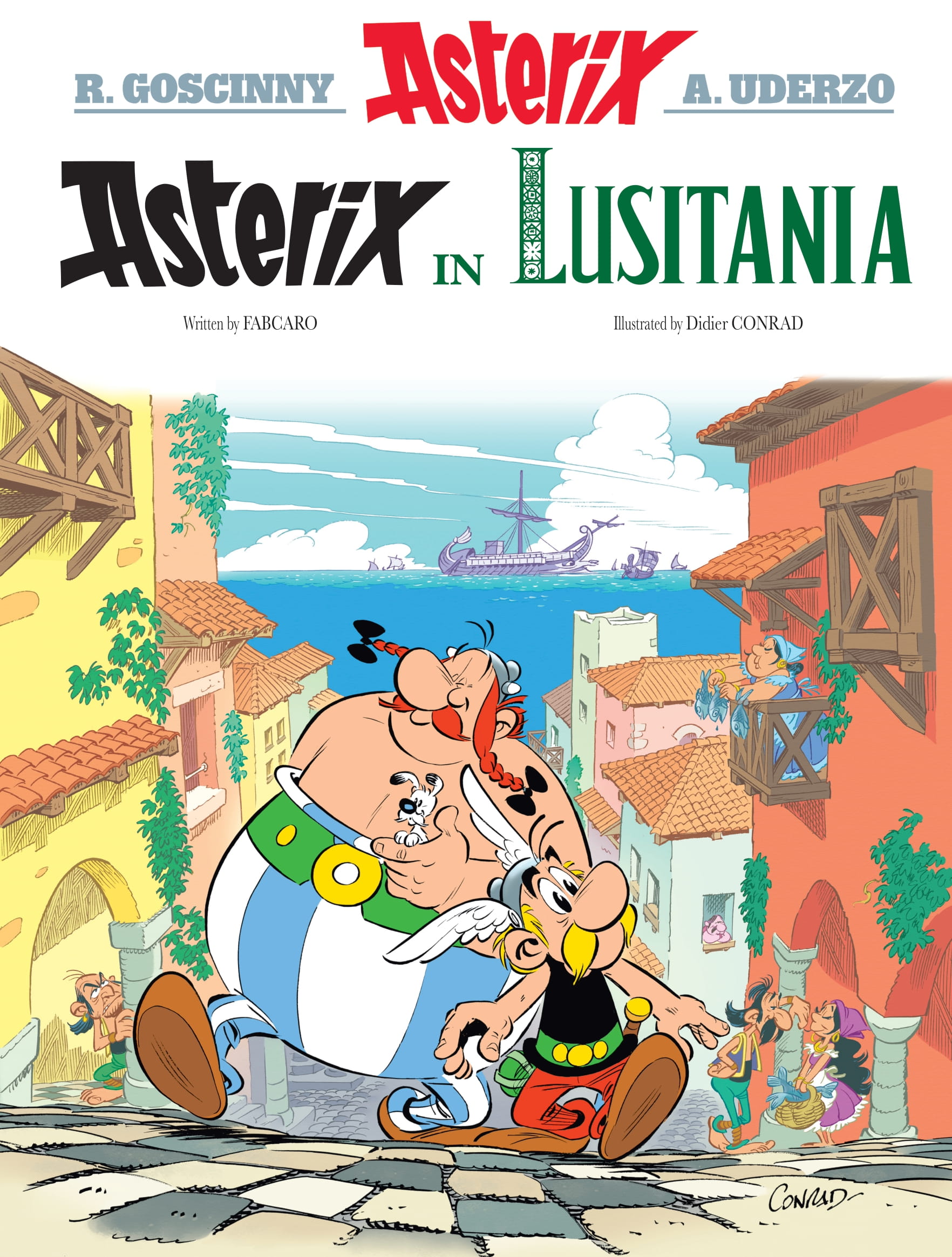
They’ve gone in every direction! Heading to the north, the south and the east… though slightly less to the west. Asterix and Obelix have frequently left their village in Armorica for journeys far and near. For their 41st adventure it’s destination Lusitania, better known these days as Portugal!
It all starts one fine morning in spring. A Lusitanian called Randomaxess arrives in the village looking for the Indomitables. His pronounciação may be a little odd but what he’s asking couldn’t be clearer: Randomaxess needs the Gauls to save his friend Umaminess, a garum producer accused of trying to poison Julius Caesar himself! There must be some evil machinação behind all this, so help from the Gauls (and their Magic Poção) will me more than welcome!
Given a lift to Lusitania by the Phoenician merchant Ekonomikrisis, Asterix and Obelix (and Dogmatix) set out and discover a whole new culture. Despite the pernicious and traitorous characters who try to thwart their mission, our valiant heroes can rely on help from their new Lusitanian friends to restore justice!
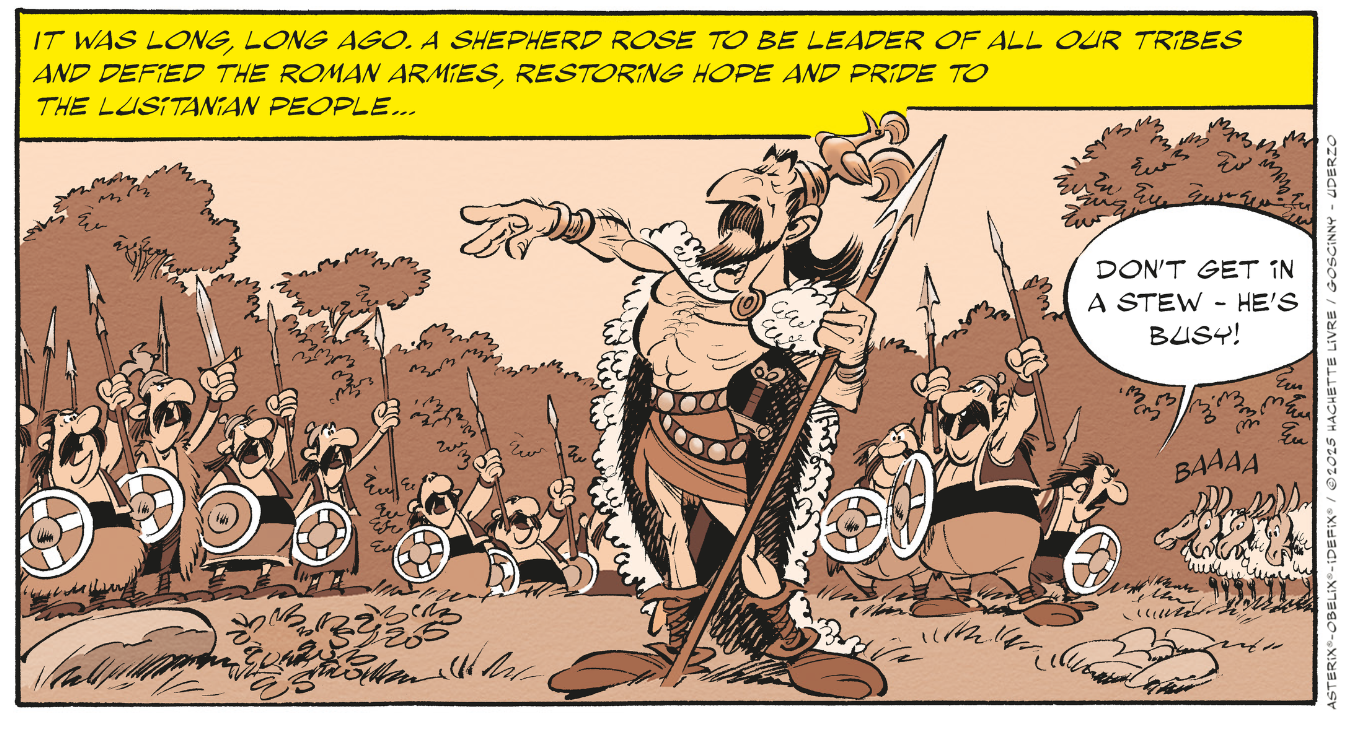
A mythical Lusitanian leader
The album makes several references to Viriato (approx. 180-139 BCE), a shepherd turned warrior who remains a very important figure in Portuguese culture to this day. Memories of this fearless warlord hang over the album in the same way that, in Asterix and the Chieftains’ Shield, the Gauls still seem to be haunted by Vercingetorix’s capitulation. Viriato’s downfall was said to have been caused when some of his friends betrayed him, and the ghost of this infamous treachery remains in this album in the form of Fethermyness, a self-serving character whose name says it all… Either way, Viriato is very much the Lusitanian Vercingetorix, the leader of a nation that put up heroic resistance to Roman invaders!
The culinary arts and other banquets!
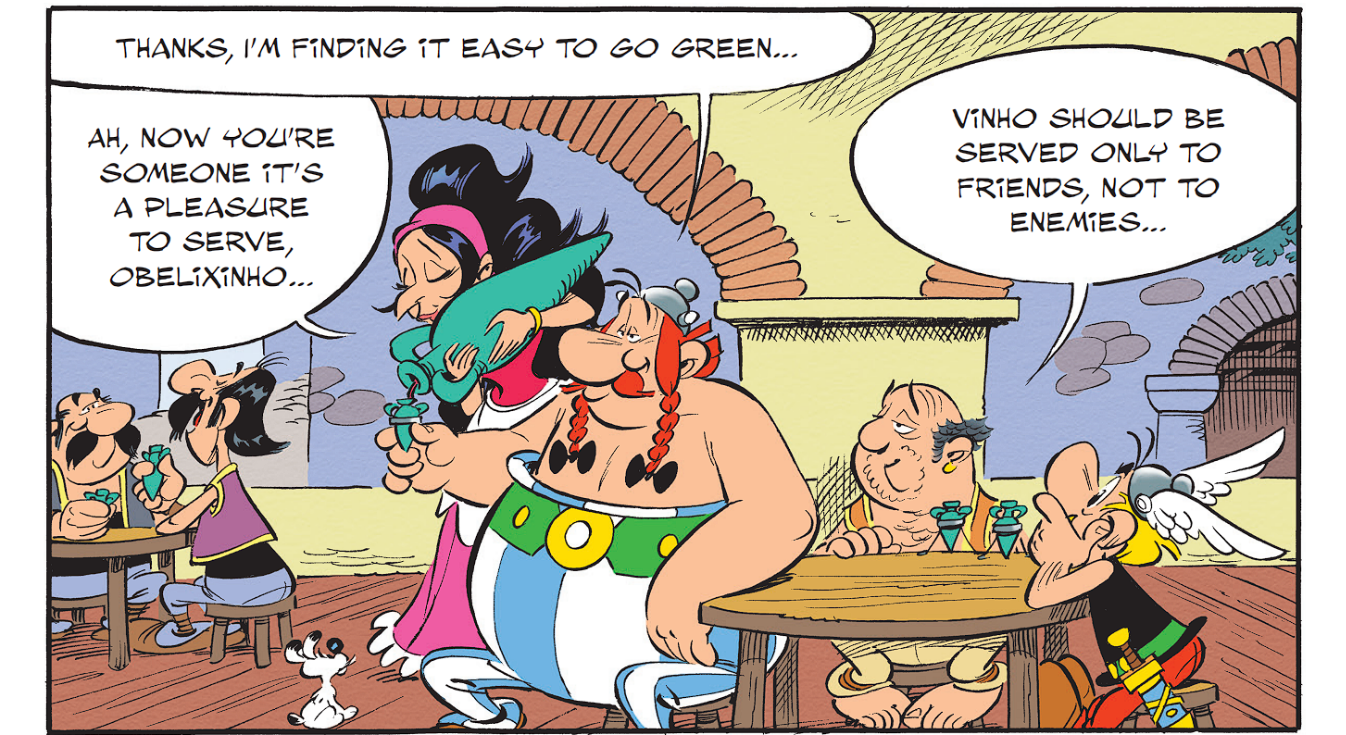
Journeys away from home are always an opportunity to try local specialities, and we can rely on Obelix not to forget this aspect of travelling! Disgusted by the very existence of garum (which he thinks is an aberration), our wild boar enthusiast is equally unimpressed with the cod they’re served for dinner on their first evening in Lusitania. It’s only when he meets Nellia, a topflight cook, that Obelix finally discovers local culinary delights. But as well as gastronomy, this trip to Lusitania introduces Asterix and Obelix to a culture of hospitality and the Lusitanian knack for a warm welcome. And our heroes are probably a little heavy-hearted to return to Gaul… after one final Lusitanian banquet, of course!
A very peculiar melancholy
To characterise the Lusitanians, Fabcaro focused on their brand of melancholy, a mood known today as saudade. It combines sadness, joy, nostalgia, defeatism and hope… a way of seeing the world that comes across in slightly tongue-in-cheek remarks. Music is another manifestation of this very distinctive melancholy, for example Amalia’s heartrending singing to welcome Asterix and Obelix to Lusitania, not forgetting the songs that the Lusitanians use to stop the Romans pursuing our heroes. A few verses in this mournful vein and the Roman troops suddenly feel demoralised, reduced to the absurdity of the human condition. They say music soothes even the fiercest souls… well, the Lusitanians seem to have grasped that right back in 50 BCE!

Lusitania and the Roman Empire in the 1st Century BCE
By Manuel NEVES, PhD, Social and Historical Anthropology from the École des Hautes Études en Sciences Sociales (School of Advanced Studies in Social Sciences)
What can you tell us about Lusitania and its people?
The first references to Lusitanians in Greco-Roman sources report a people who lived in the mountainous region of Estrela and its surroundings, in the central northern part of today’s Portugal. These pre-Celtic tribes, ruled by a rich warrior elite, lived in fortified settlements called “castros.” Communities in the highlands opted for animal husbandry and gathering, while those in the lowlands enjoyed richer, more varied agriculture.
What was the role of Lusitania in the Roman Empire?
As the Romans gradually conquered the Iberian Peninsula, Lusitania was created as a Roman province. Its importance to the empire came first and foremost from its numerous abundant mineral resources. Indeed, Lusitania was considered one of the main sources of gold for Rome. Tin production along the Lusitanian coastal region, for example, played a part in setting up maritime trade routes to the Mediterranean. Thus, as we can see, within less than a century of Romanization, Lusitania had become an indispensable part of the Roman Empire.

Can we speak of any parallels between the history of the Gauls and that of the Lusitanians?
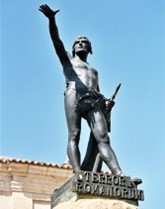
We can even talk about several parallels! First of all, they shared a common enemy: Rome. Both also had a charismatic leader: much as Vercingétorix did with the Gauls, Viriate led the Lusitanians in a rebellion that lasted eight years and went down in history. Only through treachery—by killing him in his sleep—did the Empire manage to get rid of this astute strategist. Another commonality to keep in mind: it was Julius Caesar who finally overcame the Lusitanians in 60 BCE, much as he did the Gauls ten years later.
Scoop: An interview with Asterix and Obelix about their latest adventure!
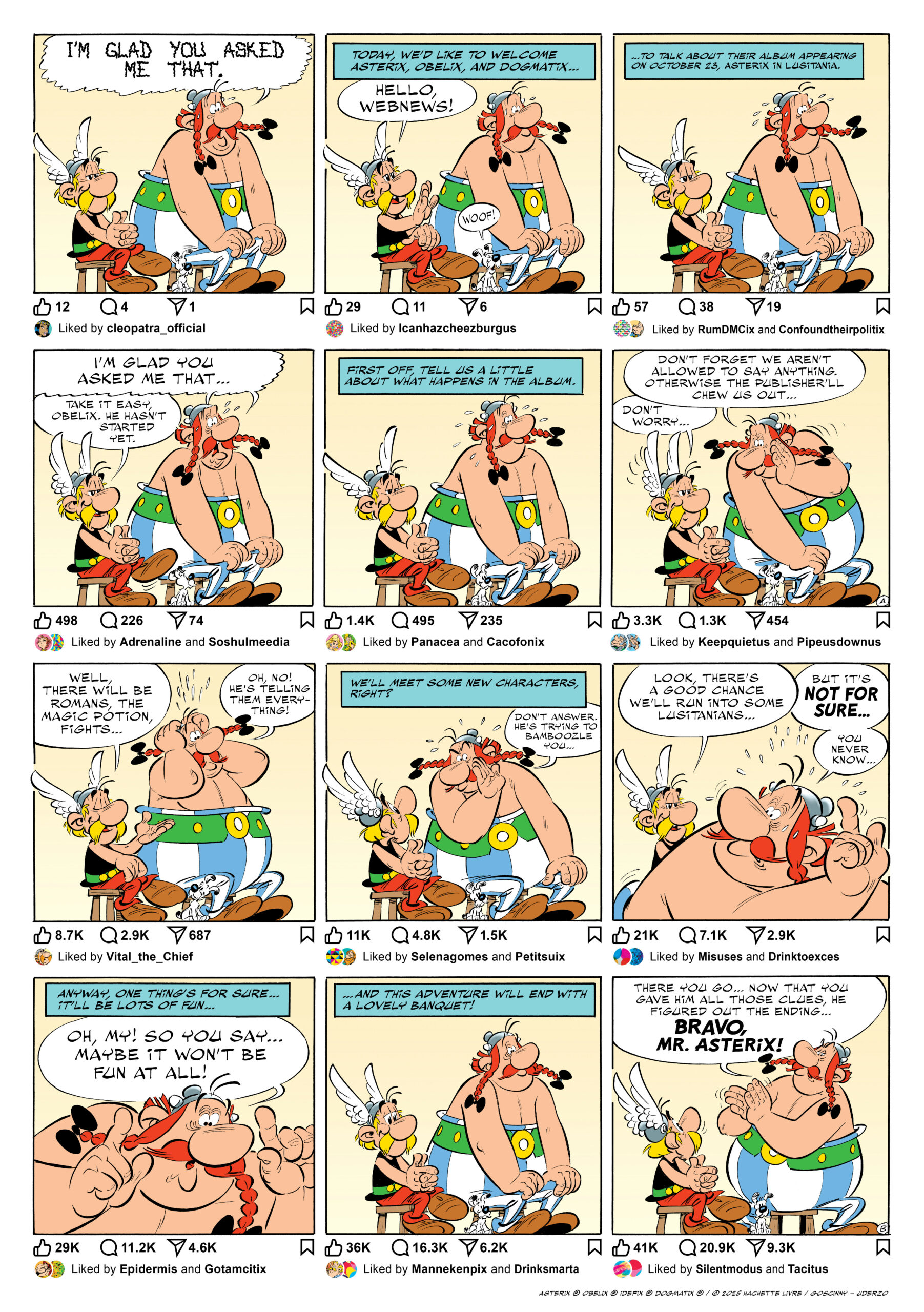
In keeping with traditions established by Goscinny and Uderzo, this latest Asterix adventure comes complete with spoof promotional interviews in the media.
In the 60s the authors devised promotional strips inspired by television culture: in 1964 Asterix and the Big Fight was publicised with a press conference featuring Vitalstatistix in very Gaulish style; the 1965 launch of Asterix in Britain saw our heroes interviewed by a fictional presenter based on the French journalist Pierre Desgraupes; and in 1970 Asterix in Switzerland was introduced in a pastiche edition of Francophonissime hosted by Pierre Tchernia.
This tradition is still going today with publicity for Asterix in Lusitania. Fabcaro and Conrad have opted for a contemporary format: a short online video of a quirky interview where the interviewer stays out of shot. True to the spirit of the series, our two heroes struggle with the need for total secrecy because of the editorial embargo. One tries to respect his instructions, the other nearly flouts them… but the mystery remains intact.
Les secrets des druides sur l’album